Start Free —100 creditsExperience AI Voice That Actually ConvertsGet Started →

16 Nov 2026
A practical buyer's guide for Indian government departments evaluating AI voice helplines, procurement eligibility, multilingual support and vendor performance.
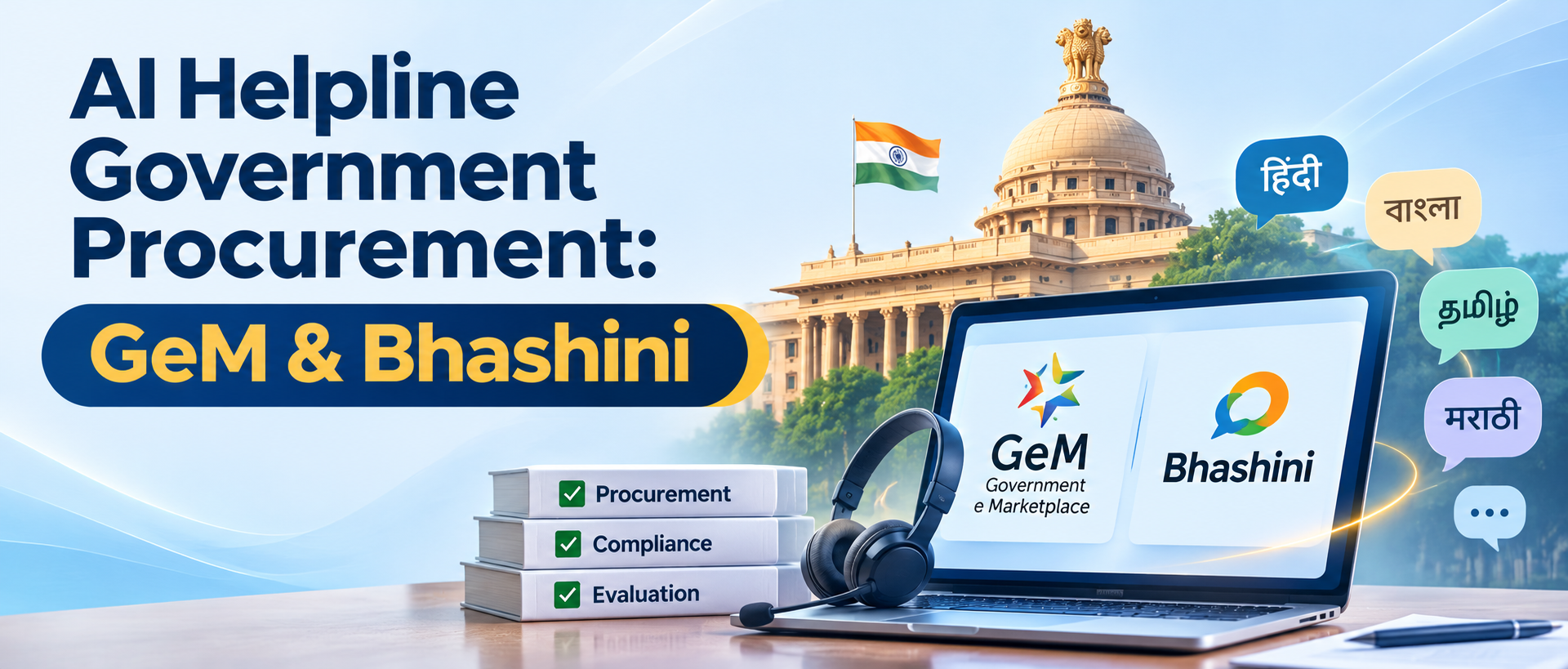
AI helpline government procurement requires more than selecting a voice AI platform. Government departments must establish the appropriate purchasing route, verify vendor eligibility, assess security and language capabilities, and evaluate performance before awarding a contract.
For an Indian public-sector buyer, the process begins with understanding the service requirement and applicable government procurement rules.
This guide explains how to approach AI helpline government procurement, including GeM applicability, Bhashini evaluation, data handling, vendor demonstrations and pilot acceptance.
A government AI helpline may support citizens seeking information about public schemes, applications, certificates, service availability or grievance procedures.
Unlike a commercial support line, it must operate within approved departmental policies and clearly defined service boundaries.
Typical requirements include:
A department should identify which enquiries can be answered automatically and which require human judgement.
For example, explaining the documents required for a welfare scheme may be suitable for automation. Determining an applicant's legal entitlement or resolving a disputed benefit decision may require an authorised officer.
This distinction should be established before beginning AI helpline government procurement.
The Government e-Marketplace (GeM) provides a procurement platform for eligible government buyers and suppliers.
Under Rule 149 of the General Financial Rules, procurement of goods and services available on GeM is mandatory for covered Central Government ministries and departments, subject to applicable provisions.
However, the purchasing route depends on whether the required service is available under an appropriate GeM category.
Procurement value | General purchasing method |
| Up to ₹50,000 | Direct purchase from an available supplier meeting requirements |
| Above ₹50,000 to ₹10 lakh | Lowest-priced eligible supplier under the specified GeM comparison conditions |
| Above ₹10 lakh | Mandatory online bidding or reverse auction through GeM |
These are general Rule 149 thresholds, not universal tender thresholds. Certain organisations have exceptions, and purchases outside GeM follow other applicable procedures.
Departments should also consult the Department of Expenditure's procurement manuals.
An important part of AI helpline government procurement is determining whether the requirement constitutes an IT project, consultancy service, non-consultancy service or mixed contract.
The 2025 Manual for Procurement of Non-Consultancy Services notes that IT projects, including certain cloud-based and system-integration services, should normally be procured as consultancy services.
Therefore, a department should not automatically classify every AI helpline subscription as routine non-consultancy procurement.
The 9 November 2026 procurement amendment introduces mandatory examination of bids priced more than 30% below the estimated cost.
The threshold triggers scrutiny, not automatic rejection.
Buyers should examine whether the proposed pricing realistically covers implementation, usage, support, maintenance and contractual commitments.
A government voice AI tender should distinguish legal eligibility from technical qualification and operational suitability.
Being technically capable does not automatically make a vendor eligible for every government contract.
During AI helpline government procurement, the evaluation committee should verify the exact tender requirements rather than applying generic assumptions.
Evaluation area | Evidence to request | Responsible reviewer |
| Procurement eligibility | Registrations, declarations and tender documents | Procurement officer |
| Technical capability | Live demonstration and system architecture | IT team |
| Multilingual support | Language-specific test calls | Language reviewer |
| Security and privacy | Hosting, access controls and data-flow documentation | Security/legal team |
| Operational readiness | Escalation, monitoring and fallback demonstration | Helpline operations |
| Commercial suitability | Itemised pricing and service commitments | Finance/procurement |
Tender authorities may prescribe additional financial, technical or experience requirements.
A fair evaluation should use published tender conditions, clearly defined criteria and documented reviewer decisions.
India's Bhashini platform supports the development of Indian-language digital experiences.
For citizen helplines, multilingual access can be particularly relevant when callers use regional languages, local accents or combinations of Hindi and English.
Official Bhashini API documentation describes capabilities and workflows involving automatic speech recognition, machine translation and text-to-speech.
A department should ask vendors to demonstrate:
The published API documentation identifies proof-of-concept usage separately from production or paid arrangements.
Therefore, AI helpline government procurement should verify integration status and production readiness independently.
A claim of multilingual support is not proof of Bhashini integration.
Equally, Bhashini integration does not automatically guarantee accurate answers to citizen enquiries. Language processing must be tested together with the helpline's government knowledge sources.
Security is a major consideration in AI helpline government procurement, particularly when citizens may disclose names, contact details, application numbers or personal circumstances.
The department should begin with a documented data-flow assessment.
Under India's Digital Personal Data Protection Act commencement notification and DPDP Rules, 2025, different provisions have different commencement dates.
As of 16 November 2026, several substantive provisions are scheduled to commence later.
Departments must therefore assess currently applicable law, forthcoming obligations, sector-specific rules and contractual restrictions separately.
A government AI helpline data residency review should establish:
India does not have one universal rule requiring every category of AI helpline data to remain within India.
The CERT-In cybersecurity directions address incident reporting and applicable ICT-system logging obligations.
Additionally, the CERT-In AI Security Auditing Guidelines, published in November 2026, provide risk-based guidance for AI security assessment.
Relevant pilot scenarios include attempts to extract private information, manipulate system instructions or trigger unauthorised actions.
Departments should also evaluate accessible digital interfaces using the Guidelines for Indian Government Websites and Apps. Telephone-only services require their own voice accessibility testing rather than assuming website accessibility standards cover everything.
A proof of concept should establish whether the system works reliably with real departmental enquiries.
For AI helpline government procurement, demonstrations should use approved test scenarios rather than exclusively vendor-selected examples.
Choose a manageable service area, such as application-status guidance, document requirements or frequently asked scheme questions.
Identify approved answer sources and the circumstances requiring human assistance.
Include common enquiries, incomplete questions, regional-language conversations, noisy calls and unusual requests.
Add negative scenarios where the AI must decline to answer or transfer the call.
Pilot metric | Measurement approach |
| Answer accuracy | Correct reviewed answers ÷ all reviewed answers |
| Escalation success | Completed required transfers ÷ all required transfers |
| Service availability | Available time ÷ agreed scheduled service time |
| Language comprehension | Correctly understood utterances ÷ reviewed utterances |
| Unsupported-answer rate | Unsupported factual answers ÷ reviewed factual answers |
Each result should be expressed as a percentage where appropriate.
The department should define acceptance thresholds, sample sizes, test languages and exclusions before the pilot begins.
Test concurrent calls, unanswered transfers, telephony failures and service recovery.
Confirm whether human operators receive enough context to continue the conversation.
The committee should record findings, failed requirements, corrective actions and the final recommendation.
A good technical score cannot compensate for failure of a mandatory tender or security condition.
A structured checklist helps procurement, IT, legal and operational reviewers assess the same evidence consistently.
The downloadable checklist provides:
Download the Government AI Helpline Procurement Checklist
Use it as a starting framework, then adapt every requirement to the department's tender and approval process.
Sicada AI develops conversational AI solutions, including voice agents designed to handle enquiries and support customer interactions.
For public-sector evaluation, relevant potential applications include routine citizen enquiries, information collection, multilingual conversations and escalation to human staff.
However, AI helpline government procurement requires these capabilities to be demonstrated against the department's actual requirements.
Sicada AI's GeM listing status, Bhashini integration, government-specific certifications and data-hosting suitability have not been established by the public information reviewed for this guide.
Government buyers should request supporting documentation and a relevant demonstration before drawing procurement conclusions.
Not universally. It depends on the buyer, procurement route, available GeM categories and applicable rules. For covered Central Government procurement of available GeM services, Rule 149 is relevant.
Not automatically. Bhashini may support language requirements, but whether integration is mandatory depends on the tender specifications.
Not every data category is subject to an identical residency requirement. Departments must review applicable legal, security, contractual and sector-specific restrictions.
They should first verify mandatory eligibility and compliance, then apply the tender's prescribed evaluation method, supported by technical evidence and pilot results where required.
That should not be the default assumption. Sensitive grievances, disputed decisions, exceptional circumstances and unresolved enquiries require an appropriate human escalation pathway.
Successful AI helpline government procurement depends on procurement compliance, technical suitability and reliable citizen service.
Government departments should first establish their service requirements and legal purchasing route. They should then verify vendor qualifications, multilingual capabilities, security controls and operational readiness through documented evaluations.
A structured pilot can reveal weaknesses that a standard product demonstration may miss.
For departments exploring conversational AI, Sicada AI can be considered for an initial product discussion, with government-specific capabilities and eligibility subject to verification.
Talk to Sicada AI to discuss the proposed citizen helpline workflow and the evidence required for a departmental evaluation.
AI-powered Voice, Chat, Interviews- designed to save time, costs and build efficiency.
Follow us on


Products
Resources
Others
All rights reserved. Powered by Edysor