Start Free —100 creditsExperience AI Voice That Actually ConvertsGet Started →

17 Nov 2026
An operational guide for logistics and last-mile delivery teams to identify onboarding barriers, support inactive partners and measure first-trip activation.
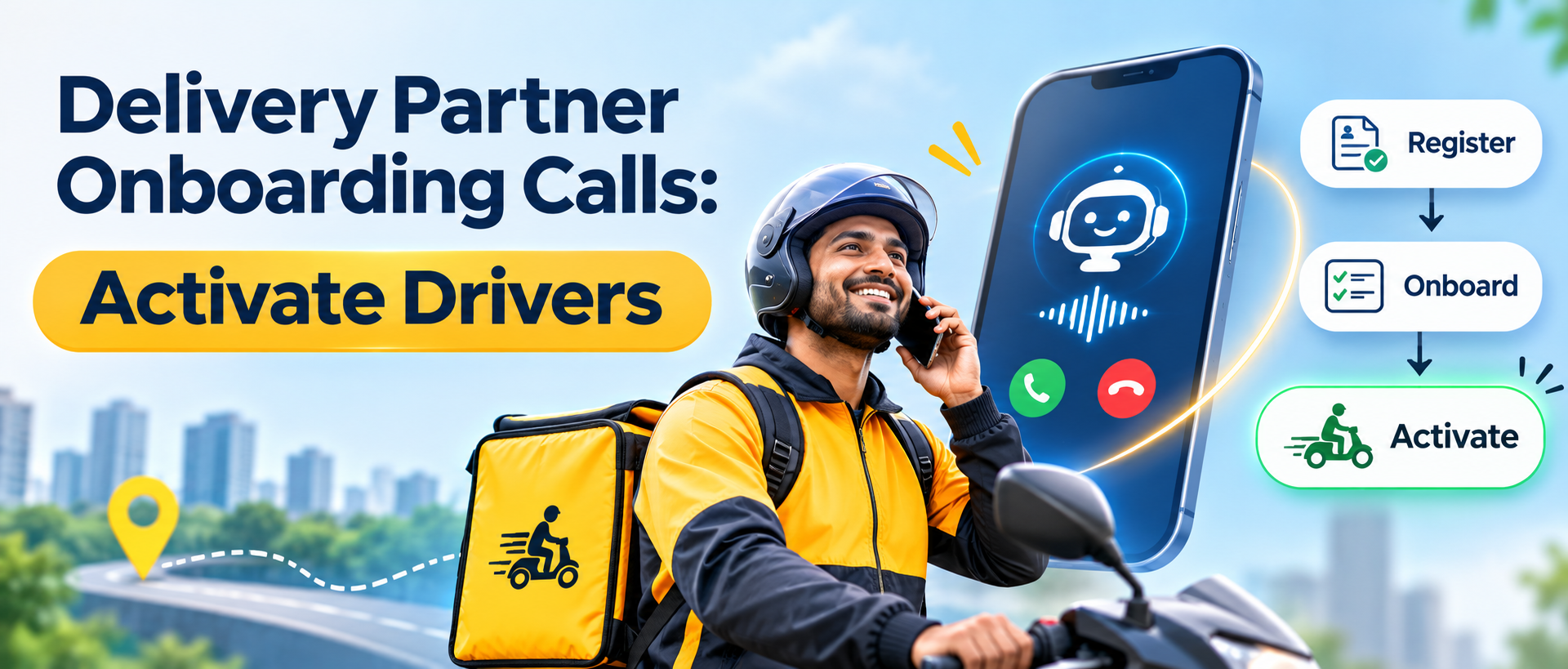
A delivery partner registers, submits basic information and downloads the delivery app. But days later, the first order remains incomplete.
Delivery partner onboarding calls help logistics companies contact these inactive partners, identify what is preventing them from starting work and coordinate the next onboarding action.
The problem is not always a lack of interest. Pending documents, verification delays, app difficulties or uncertainty about available shifts can interrupt the process.
A structured system of delivery partner onboarding calls gives operations teams a way to investigate these issues rather than repeatedly sending generic reminders.
The objective is simple: move eligible partners from registration to their first successfully completed delivery, while measuring what happens at every stage.
Registration is only the beginning of the onboarding journey.
For example, Blinkit's official delivery-partner information explains that partners must complete document submission, background verification and onboarding training before becoming eligible to deliver orders.
Similarly, Swiggy's delivery-partner onboarding page identifies document submission and profile completion as part of the joining process.
These requirements create several possible points where a partner may need assistance.
Onboarding barrier | Possible partner difficulty | Appropriate follow-up |
| Document verification | Missing, unclear or pending documents | Explain the required action or refer to verification support |
| App access | Login failure, installation issue or unfamiliar interface | Provide approved troubleshooting guidance |
| Training incomplete | Partner has not completed mandatory training | Explain how to access the training process |
| Scheduling uncertainty | Unclear shift availability or preferred working hours | Clarify the platform's actual scheduling process |
| Equipment or vehicle issue | Required equipment or vehicle is unavailable | Refer to the relevant onboarding team |
| Changed interest | Partner no longer wants to deliver | Record the decision and stop activation follow-ups |
These are potential operational barriers, not verified statistics about why drivers become inactive.
Delivery partner onboarding calls should identify the actual problem before assigning a follow-up action.
A registered delivery partner is not necessarily ready to accept orders.
For operational tracking, logistics businesses should distinguish three stages:
This distinction matters because an account being approved is not proof that an order was delivered.
Effective delivery partner onboarding calls should focus on the specific stage where progress has stopped.
For instance, a partner awaiting document verification needs a different conversation from someone whose account is active but who cannot understand how to accept an order.
Automated delivery partner onboarding calls can form part of a structured follow-up process that identifies obstacles and sends relevant issues to the responsible team.
Instead of making every call a generic reminder, logistics operators can design conversations around a partner's current onboarding status.
The process should distinguish routine questions from situations requiring human intervention.
Step | Operational action | Expected record |
| 1. Identify | Select registered partners without a verified first trip | Eligible contact list |
| 2. Validate | Check account stage, contact permissions and suppression status | Approved calling cohort |
| 3. Contact | Place an onboarding assistance call | Attempt and contact status |
| 4. Diagnose | Ask about documents, app access, training or availability | Issue category |
| 5. Resolve | Provide approved guidance or escalate | Action and assigned owner |
| 6. Verify | Check whether the partner completes the first trip | Verified activation status |
The workflow should not automatically mark a partner as activated simply because they answered the call or promised to start working.
The first-trip event must be checked against the logistics company's operational records.
For teams evaluating an automated calling system, Sicada's 30-day AI voice-agent pilot guide provides a framework for testing completion, accuracy and escalation before expanding deployment.
A useful delivery partner onboarding calls programme needs natural conversations, particularly when partners prefer Hindi or a combination of Hindi and English.
The following script is a customizable operational example, not a transcript of an existing Sicada customer campaign.
AI Agent:
"Namaste! Main [Company Name] ki onboarding support team se baat kar raha/rahi hoon. Yeh ek automated assistance call hai.
Aapne hamare delivery partner programme ke liye registration kiya tha, lekin hamare record ke hisaab se aapki first delivery abhi complete nahi hui hai.
Kya aapke paas onboarding ke baare mein baat karne ke liye do minute hain?"
If the partner agrees:
"Dhanyavaad! Kya aapko documents, delivery app, training ya delivery start karne mein koi dikkat aa rahi hai?"
Partner: "Mere documents verify nahi hue hain."
AI Agent:
"Samajh gaya. Aapko document submit karne mein problem aa rahi hai, ya verification abhi pending hai? Main aapki problem onboarding support team tak pahunchane mein madad kar sakta/sakti hoon."
Action: Record the verification issue and create an approved support follow-up.
Partner: "App login nahi ho raha."
AI Agent:
"Samajh gaya. Kya app open nahi ho raha, ya login karte waqt error aa raha hai? Agar aap chahein toh main app support team se help arrange karne ke liye request record kar sakta/sakti hoon."
Action: Classify the technical issue and route it to support.
Partner: "Mujhe samajh nahi aa raha delivery kab start karni hai."
AI Agent:
"Koi baat nahi. Aapko kis time delivery karna convenient rahega, morning, afternoon ya evening? Main aapki preference note kar leta/leti hoon. Available slots ki confirmation company ke process ke according hogi."
Action: Capture preferred availability without promising an unverified slot.
Partner: "Mujhe kisi person se baat karni hai."
AI Agent:
"Bilkul. Main aapki request onboarding support team tak forward karne ke liye record kar raha/rahi hoon."
Action: Initiate the configured human-support process.
"Dhanyavaad! Aapki problem aur next action note kar liya gaya hai. Hamari team approved process ke according aapse sampark karegi. Aapka din shubh ho!"
If the partner declines further contact, the workflow should respect that choice and update the relevant suppression records.
Important: The agent should never ask for an OTP, password or sensitive identity-document information over the call.
The effectiveness of delivery partner onboarding calls should be assessed using verified onboarding outcomes, not total calls placed.
A company may make hundreds of attempts without resolving the issues preventing partners from delivering.
The following weekly scorecard can be copied into Excel or Google Sheets.
Week | Registered partners | Contacted partners | Activated partners | Avg. time to first trip | Open issues |
| Week 1 | [Enter] | [Enter] | [Enter] | [Hours/days] | [Enter] |
| Week 2 | [Enter] | [Enter] | [Enter] | [Hours/days] | [Enter] |
| Week 3 | [Enter] | [Enter] | [Enter] | [Hours/days] | [Enter] |
| Week 4 | [Enter] | [Enter] | [Enter] | [Hours/days] | [Enter] |
Template fields are intentionally blank. No actual customer results or industry benchmarks are assumed.
1. First-trip activation rate
Partners completing their first trip within a defined reporting window ÷ partners in the registered cohort × 100.
2. Contactability
Unique partners successfully reached ÷ unique eligible partners attempted × 100.
A successful connection should be distinguished from an unanswered call.
3. Time to first trip
Time between a partner's registration timestamp and first completed-trip timestamp.
Report this metric for activated partners and use the same starting event across all cohorts.
4. Unresolved onboarding issue rate
Partners with unresolved onboarding issues ÷ partners with identified onboarding issues × 100.
Record each issue's owner, status and next review date.
For meaningful weekly comparisons, companies should define their activation window, exclude duplicate partner records and separately report newly registered versus previously inactive cohorts.
Delivery partner onboarding calls become more useful when these measures reveal whether partners are progressing, repeatedly encountering the same problem or waiting for support.
A delivery partner may understand the general onboarding process but struggle with technical terminology or app instructions in English.
Offering an understandable conversation in the partner's preferred language can make it easier to explain the problem.
However, bilingual support is more than translating a standard English script.
Sicada's voice UX localisation checklist discusses language adaptation, conversational design and testing for different user contexts.
For delivery partner onboarding calls, an implementation should test:
Complex disputes, repeated verification failures, safety concerns and account restrictions should remain accessible to trained human teams.
Sicada.ai provides AI voice-agent capabilities that can be evaluated for structured partner follow-up workflows.
Its official Voice API documentation describes campaign creation, recipient records, scheduled calls, campaign statistics and conversation information.
These capabilities provide a technical foundation for evaluating delivery partner onboarding calls.
A logistics company could assess a proposed configuration that:
Actual logistics-system integrations, bilingual performance and live human-transfer behaviour must be confirmed during implementation. These should not be assumed merely because general API capabilities exist.
Outbound delivery partner onboarding calls must be designed around the applicable calling permissions, regulatory classification and appropriate handling of partner information.
In India, the Telecom Regulatory Authority of India regulates commercial communications. TRAI introduced the 1601 numbering series for service and transactional calls covering logistics and delivery entities in August 2026.
Companies should confirm with their telecom provider which numbering, registration and communication rules apply to their specific calls.
The November 2026 TRAI Fourth Amendment also defers the commencement of Regulation 35A to a separately notified date.
For personal information, organisations should review India's Digital Personal Data Protection Rules, 2025, including their phased commencement.
Operational safeguards should include consent and permission checks, appropriate calling windows, suppression controls, restricted data access and retention procedures.
Automation does not independently guarantee regulatory compliance.
AI calls can help identify onboarding obstacles and coordinate assistance. Activation should count only after the partner completes a verified first delivery.
A company should define follow-up triggers based on the partner's actual onboarding stage, eligibility and contact permissions. There is no universally established interval suitable for every platform.
Routine follow-ups may be suitable for automation, but complex verification problems, disputes and sensitive exceptions still require human support.
Segment inactive partners, identify specific problems, assign resolution owners and verify first-trip completion through delivery records. Compare results against the existing onboarding process.
Delivery partner onboarding calls offer logistics companies a structured way to understand why registered partners have not started delivering.
The most useful approach combines accurate partner segmentation, relevant automated conversations, bilingual assistance, human escalation and reliable first-trip tracking.
Success should not be measured by the number of calls completed. It should be measured through verified activation, contactability, time to first trip and unresolved onboarding issues.
Before scaling, companies should test the workflow against real operational scenarios and confirm that their calling, integration and support processes function correctly.
Want to evaluate delivery partner onboarding calls for your logistics operations? Explore Sicada AI and discuss a controlled voice-agent pilot for your onboarding workflow.
AI-powered Voice, Chat, Interviews- designed to save time, costs and build efficiency.
Follow us on


Products
Resources
Others
All rights reserved. Powered by Edysor